In short
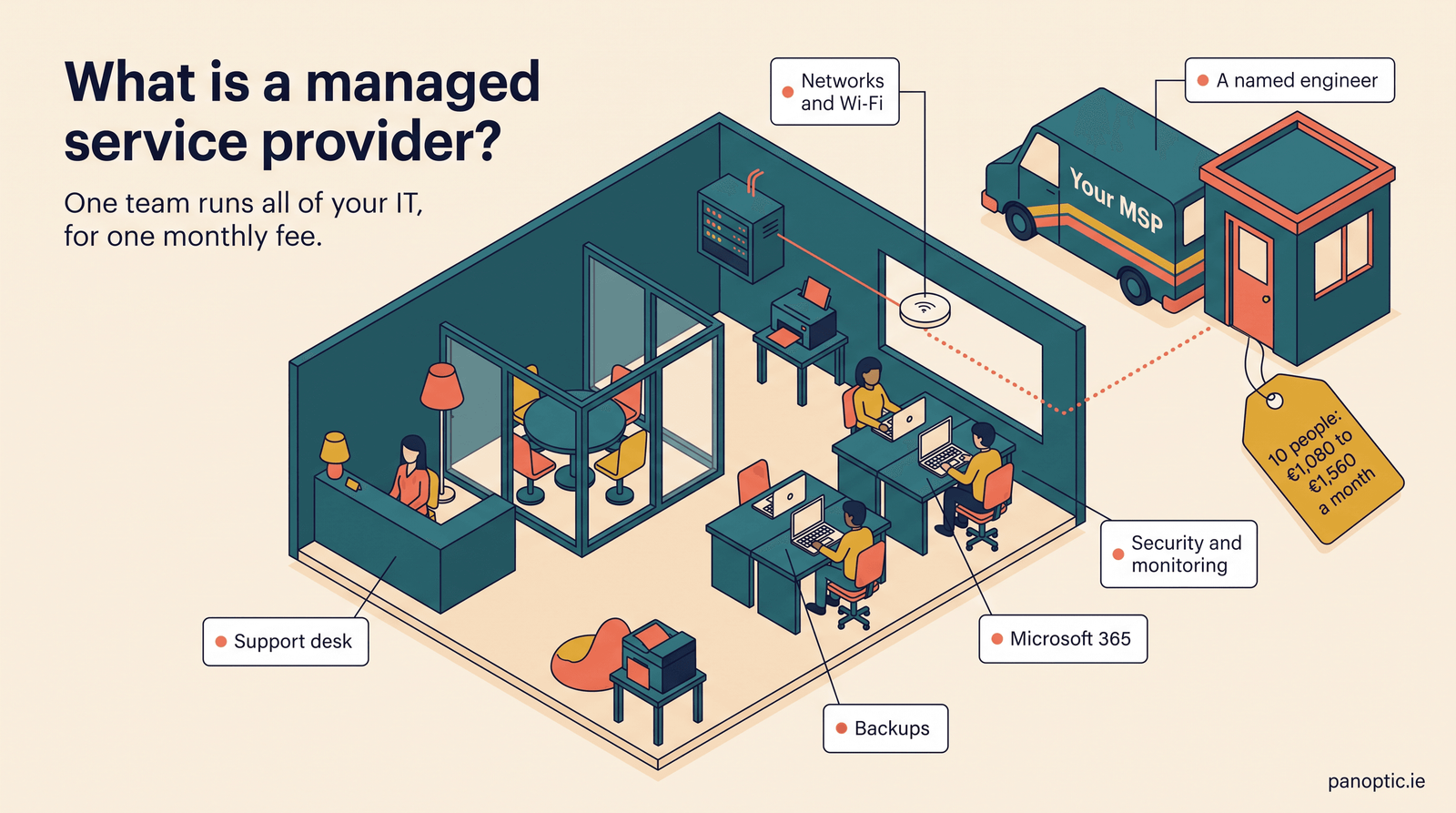
MSP stands for managed service provider: a company that runs your IT (support desk, security, backups, Microsoft 365, networks) for a fixed monthly fee instead of billing you per callout. In Ireland, holistic providers price this per person and device. Panoptic's own plans run from roughly €1,080 to €1,560 a month for a 10-person, 15-device setup, once you add security monitoring and Microsoft 365 licensing.
MSP stands for managed service provider. It's a company that takes over the day-to-day running of your IT, support, security, backups, and infrastructure, for a fixed monthly fee instead of charging you every time something breaks.
In Ireland, most SMEs meet this model through a holistic provider: one team that handles your devices, your network, your Microsoft 365 tenant and your security baseline together, priced per person and per device each month. This guide covers what an MSP does, what one costs here, how it compares with hiring in-house, and what to check before you sign.
What does MSP stand for, and what does an MSP do
MSP stands for managed service provider. The term covers any company that runs a system on your behalf under an ongoing contract, but when people search for it in an IT context, they usually mean an IT managed service provider.
A holistic IT MSP typically covers:
- Support desk. A team you call or email when something breaks, with a response-time commitment rather than a best-effort promise.
- Monitoring and patching. Devices, servers and cloud tenants watched around the clock, with security and software updates applied on a schedule rather than left to chance.
- Security baseline. Endpoint detection, multi-factor authentication (MFA) enforcement, and credential monitoring across every account and device.
- Backup. Encrypted, tested backups of the systems and data you can't afford to lose.
- Microsoft 365 (or Google Workspace) administration. Licensing, mailboxes, permissions and device policy managed as part of the fee, not billed separately.
- Networks. Wi-Fi, switches, firewalls and VPN, configured, monitored and kept up to date after the install.
- A named engineer and a roadmap. Someone who knows your setup, plus a periodic review of what to fix or upgrade next, rather than a different technician each time and no forward plan.
Some MSPs stop at support and monitoring and leave security, backup or Microsoft 365 as paid extras. We recommend you check what's inside the headline price before you compare two quotes. Our guide on choosing an MSP in Ireland has the full checklist.
Examples of managed services
To make this concrete, here's what a managed service looks like at the scale of a typical Irish SME:
- A 12-person accountancy firm has its laptops enrolled in device management, so a lost laptop can be locked and wiped remotely instead of becoming a data breach.
- A dental practice has its patient-management server backed up nightly and tested monthly, so a ransomware attempt costs a restore, not a ransom.
- A creative agency has MFA enforced on every account, so a stolen password alone can't get an attacker into the company's email or files.
- A wholesale distributor has its warehouse Wi-Fi and barcode scanners monitored as one network, so a dropped connection gets fixed before it stops picking and packing.
Each of these is a small piece of a bigger managed IT contract: monitoring, security and support working together rather than as separate purchases.
How much does a managed service provider cost in Ireland
Irish MSPs generally price per person and per device each month, not by the hour and not by the ticket. That's the headline difference from break-fix support, which bills €75 to €150 an hour with no ceiling on a bad month, as we cover in our managed IT vs break-fix guide.
For a holistic plan, that guide puts the market range in Ireland at €75 to €150 per user per month. What drives you toward the top or bottom of that range:
- How many devices you run. A laptop-only team costs less to support than one with laptops, desktops, servers and mobiles.
- What's included. A plan bundling security monitoring, Microsoft 365 licensing and backup costs more than bare-bones support, but you're not buying those separately elsewhere.
- Compliance requirements. Healthcare, financial services and other regulated sectors need more logging, more documentation and more security controls, which adds cost.
- Response-time commitments. Faster first-response service-level agreements (SLAs) cost more to staff than best-effort support.
As a real example, our own plans for a 10-person, 15-device business, with security monitoring and Microsoft 365 licensing included, run from roughly €1,080 to €1,560 a month. See our pricing page for what sits inside that range and what changes the number for your setup. A free IT review and discovery call gets you an exact quote; we don't publish a single flat rate because the right plan depends on what you're running.
MSP vs in-house IT
The other option is hiring an IT person directly. The average salary for IT support in Ireland is €37,574 a year, according to Indeed's 2026 salary data. That's before employer costs like PRSI, before a laptop, training and any tools they need, and before you've covered what happens when they're on holidays or out sick.
One person, however good, can't be in two places at once. A single in-house hire typically can't cover:
- Out-of-hours cover. Security incidents and server failures don't wait for 9 to 5, and a solo hire needs sleep.
- Holidays and sick leave. Your only IT person being unreachable for two weeks is a real operational risk.
- Breadth. Networking, security, Microsoft 365 administration and end-user support are different skill sets. One person is usually strong in some and weak in others.
- Second opinions. An in-house hire has no one to sanity-check a decision. An MSP has a wider team and a track record across other clients.
For a 10-person business, our managed IT costs €1,080 to €1,560 a month. One IT support salary at the Indeed average works out at about €3,130 a month before employer PRSI and equipment. The MSP fee buys a team with holiday, sick-leave and out-of-hours cover; the salary buys one person's working week. In-house IT starts to make sense at a larger headcount, usually alongside an MSP rather than in place of one.
MSP vs MSSP, and MSP vs break-fix
An MSSP, managed security service provider, is narrower than an MSP: it covers security monitoring and response only, not general IT support, devices or backup. A holistic MSP includes the MSSP's job as part of a wider service, rather than as a separate contract you have to coordinate yourself.
Break-fix is the older model: you call someone when something breaks, and they charge for the callout. There's no monitoring, so problems get caught after they've caused downtime, not before. Our holistic managed IT vs break-fix guide covers the full comparison, including when break-fix still makes sense for a very small team.
How an MSP makes money
An MSP charges a flat monthly fee, usually per person or per device, rather than billing for each hour of work or each support ticket. That changes the incentive: a provider paid by the ticket makes more money when things break. A provider paid a flat fee makes more money when things don't break, because fewer support calls means lower cost to serve you at the same price.
This is why monitoring, patching and a security baseline are usually included rather than optional. Preventing an incident costs the MSP less than responding to one, so a well-run flat-fee provider invests in prevention.
What to check in an MSP contract
Before you sign, we recommend you check:
- Contract term and notice period. How long you're locked in, and how much notice either side needs to give to end it.
- Exit and data handover. Whether your backups, password vault and Microsoft 365 tenant transfer to you or a new provider if you switch, and in what format.
- Response times. Whether SLAs are priority-banded (a down server treated differently from a printer issue), with first-response and resolution targets for each band.
- What's excluded. Which security items, licensing or project work sit outside the monthly fee, so you're not surprised by an invoice later.
Our guide to choosing an MSP in Ireland walks through a full 12-point framework for comparing providers side by side.
MSPs and NIS2
If your business falls inside the scope of the NIS2 directive, either directly or as a supplier to a company that does, your IT provider becomes part of your compliance picture as well as your support desk. NIS2 expects logging, incident reporting and a documented security baseline, which is easier to demonstrate when one team already runs your monitoring, patching and access controls together.
An MSP doesn't make you NIS2 compliant on its own. It gives you the operational evidence, patch records, MFA enforcement, monitored backups, that a compliance assessment asks for. See our NIS2 requirements guide for Ireland for what's in scope and what to have ready.
Next steps
If you're comparing providers, our guide on how to choose an MSP in Ireland has a full checklist. To see what a plan looks like for a business your size, visit our pricing page or managed IT services. If you'd like a free IT review, get in touch.
Sources
- Panoptic pricing page: https://panoptic.ie/pricing
- Panoptic guide, managed IT vs break-fix in Ireland: https://panoptic.ie/guides/holistic-managed-it-vs-break-fix-ireland
- Panoptic guide, how to choose an MSP in Ireland: https://panoptic.ie/guides/how-to-choose-msp-ireland
- Panoptic guide, NIS2 requirements in Ireland: https://panoptic.ie/guides/nis2-requirements-ireland
- Indeed, IT support salary in Ireland (2026): https://ie.indeed.com/career/it-support/salaries
- DataForSEO live SERP and keyword data, Ireland, pulled 2026-09-24
What does MSP stand for?
MSP stands for managed service provider, a company that runs an ongoing system, such as IT, on a client's behalf under contract, usually for a fixed recurring fee.
What is an example of a managed service?
Nightly, tested backup of a business's server is a managed service: the MSP monitors the backup job, tests it can be restored, and fixes it if it fails, without you having to ask.
How much is a managed service provider?
In Ireland, holistic MSPs typically price between €75 and €150 per user per month, depending on what's included and your compliance needs. Panoptic's own plans for a 10-person, 15-device business run from roughly €1,080 to €1,560 a month. See our pricing page for a breakdown.
Is managed IT better than in-house IT?
For most SMEs, an MSP covers more ground than one in-house hire: out-of-hours cover, holiday and sick leave cover, and a wider range of skills. A single employee costs less at very small scale but can't provide the same breadth or availability.
How does an MSP make money?
Through a flat monthly fee, usually per person or device, rather than by billing per hour or per ticket. This aligns the provider's incentive with preventing problems rather than responding to them.
What is the difference between an MSP and an ISP?
An ISP (internet service provider) sells you a connection to the internet. An MSP manages the systems that run on top of that connection: your devices, network, security and support. Many businesses use both, an ISP for connectivity and an MSP to run everything else.